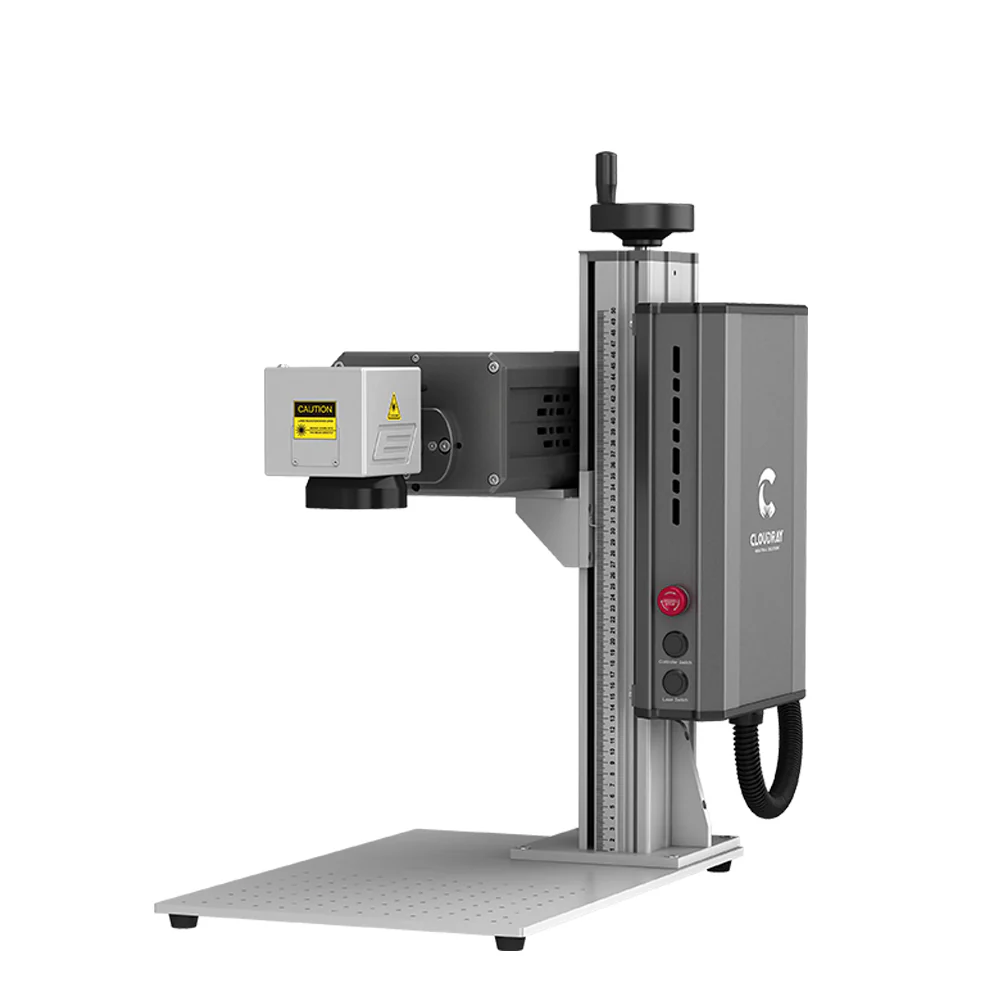
A 300W pulsed laser cleaner is an industrial surface-cleaning system that uses short, high-peak-power laser pulses to remove rust, paint, oil, oxide layers, weld marks, and other contaminants from material surfaces.
Unlike traditional grinding, sanding, chemical cleaning, or sandblasting, pulsed laser cleaning is a non-contact process. The laser energy is absorbed by the contaminant layer, causing it to heat, expand, vaporize, or detach from the surface. When the parameters are properly controlled, the contaminant can be removed while minimizing damage to the base material.
Cloudray’s 300W Portable Trolley Pulse Fiber Laser Cleaning Machine is designed for users who need stronger cleaning capability than low-power handheld units, while still maintaining the control advantages of pulsed laser cleaning.
Why Higher Power Does Not Always Mean Better Cleaning
When choosing a laser cleaning machine, many buyers first compare power levels: 100W, 200W, 300W, or 500W. Power is important, but it is not the only factor that determines cleaning quality.
A higher-power laser can improve cleaning efficiency, especially on larger areas or thicker contamination. However, good laser cleaning is not simply about removing material quickly. The real goal is:
Remove the unwanted layer effectively while keeping the base material as intact as possible.
For example, removing thick rust from steel and cleaning oxide from aluminum are very different tasks. One requires stronger energy delivery, while the other requires more careful heat control. This is why a pulsed laser cleaner should be evaluated by its full parameter range, not only by its wattage.
Why Choose a Pulsed Laser Cleaner Instead of a CW Laser Cleaner?
Laser cleaners are generally divided into two major types: pulsed laser cleaners and continuous wave laser cleaners.
A continuous wave laser outputs laser energy continuously. It is often suitable for large-area, heavy-duty cleaning, such as thick rust or heavy paint removal on steel structures. However, because the heat input is continuous, it can increase the risk of overheating, discoloration, or surface damage on sensitive materials.
A pulsed laser cleaner releases energy in short bursts. The peak power of each pulse is high, but the total heat input can be more controlled. This makes pulsed laser cleaning especially useful for applications where surface quality matters.
Pulsed laser cleaning is commonly preferred for:
- Aluminum oxide removal
- Mold cleaning
- Weld mark cleaning
- Precision metal parts
- Thin rust removal
- Light paint or coating removal
- Cleaning surfaces where heat damage must be reduced
For users who need a balance between cleaning strength and surface protection, a 300W pulsed laser cleaner is often a practical choice.
The Key to Laser Cleaning: Ablation Threshold vs. Damage Threshold
To understand laser cleaning, it helps to understand two important concepts: the ablation threshold and the damage threshold.
The ablation threshold is the energy level at which the contaminant begins to be removed. The damage threshold is the energy level at which the base material may start to be affected or damaged.
The ideal laser cleaning process keeps the laser energy:
Above the contaminant’s ablation threshold, but below the base material’s damage threshold.
This is why parameter control is so important. If the energy is too low, the rust, paint, oil, or oxide layer may not be removed effectively. If the energy is too high, the base material may be overheated, roughened, discolored, or damaged.
Cloudray’s 300W pulsed laser cleaner provides adjustable power, pulse width, frequency, and scanning patterns, giving users more flexibility to match different materials and cleaning tasks.
Important Parameters of a 300W Pulsed Laser Cleaner
1. Average Output Power
Average power affects cleaning speed and processing capability. A 300W pulsed laser cleaner provides stronger cleaning performance than lower-power models, making it suitable for many industrial maintenance and restoration tasks.
Cloudray’s 300W model provides over 300W average output power, making it suitable for rust removal, paint removal, oil removal, oxide removal, and weld cleaning.
2. Pulse Energy
Pulse energy determines how much energy is delivered in each laser pulse. Higher pulse energy can help remove tougher contamination, but it must be controlled carefully to avoid damaging the base material.
For heavy rust or thicker oxide layers, stronger pulse energy may improve cleaning efficiency. For delicate surfaces, lower energy settings are usually safer.
3. Pulse Width
Pulse width refers to how long each laser pulse lasts. Shorter pulse widths usually create a more concentrated interaction with the surface, while longer pulse widths can spread the energy over a slightly longer time.
Cloudray’s 300W pulsed laser cleaner supports a wide pulse width range, giving users room to adjust the cleaning behavior for different materials and surface conditions.
4. Frequency
Frequency determines how many laser pulses are emitted per second. Higher frequency can create a smoother and more uniform cleaning process, while lower frequency can deliver stronger energy per pulse depending on the setting.
For tough rust or oxide layers, higher frequency with proper scanning speed can improve cleaning consistency. For sensitive materials, frequency should be tested carefully to avoid excessive heat accumulation.
5. Scanning Speed and Cleaning Pattern
Scanning speed controls how long the laser stays on one area. If the speed is too slow, heat may accumulate. If the speed is too fast, the cleaning may be incomplete.
Cloudray’s 300W laser cleaner supports multiple scan patterns, including line, circle, rectangle, spiral, sine, and fill patterns. Different patterns help users adapt to flat surfaces, curved parts, weld seams, corners, and irregular workpieces.
What Can a 300W Pulsed Laser Cleaner Remove?
Cloudray’s 300W pulsed laser cleaner is suitable for a wide range of surface cleaning applications.
Rust Removal
Rust removal is one of the most common applications. A 300W pulsed laser cleaner can remove light to medium rust from metal surfaces while reducing the need for sanding, grinding, or chemical treatment.
Typical objects include:
- Steel plates
- Machine parts
- Automotive parts
- Tools
- Frames
- Pipes
- Metal fixtures
- Restoration parts
Paint Removal
Pulsed laser cleaning can remove paint layers from metal surfaces with better control than many mechanical methods. It is useful when users need to remove old paint before repainting, welding, repairing, or restoring a part.
Typical applications include:
- Automotive restoration
- Metal furniture repair
- Industrial equipment maintenance
- Localized paint stripping
- Pre-treatment before coating
Oxide Layer Removal
Oxide layers can affect welding, coating, bonding, marking, or electrical conductivity. A pulsed laser cleaner can remove oxide layers from metal surfaces without direct contact.
This is especially useful for:
- Aluminum parts
- Stainless steel components
- Weld preparation
- Surface pre-treatment
- Precision metal processing
Weld Cleaning
Weld marks, discoloration, and surface residues can be cleaned with laser energy. Compared with manual brushing or chemical cleaning, laser weld cleaning can reduce consumable use and improve processing consistency.
Common use cases include:
- Stainless steel weld cleaning
- Carbon steel weld preparation
- Post-weld surface finishing
- Fabrication shops
- Metalworking workshops
Oil and Surface Contaminant Removal
Oil, grease, carbon deposits, and surface dirt can also be removed in many cases, depending on the thickness and material type. For best results, parameters should be tested on a sample area before full cleaning.
Why 300W Is a Practical Power Level for Industrial Cleaning
A 300W pulsed laser cleaner is often selected by users who need more efficiency than 100W or 200W systems, but still want better heat control than many heavy-duty CW cleaning machines.
It is suitable for:
- Small and medium industrial workshops
- Automotive repair and restoration
- Metal fabrication shops
- Equipment maintenance teams
- Mold cleaning users
- Surface preparation before welding or coating
- Contractors offering laser cleaning services
Compared with a lower-power pulsed laser cleaner, a 300W system can process tougher contamination and larger areas more efficiently. Compared with some high-power CW systems, it offers better control for users who care about surface quality and base material protection.
Air Cooling Makes the System More Portable
Cloudray’s 300W pulsed laser cleaner uses air cooling. This helps reduce the complexity of the system compared with water-cooled cleaning machines.
For users who need a mobile cleaning setup, air cooling can offer several advantages:
- No external chiller required
- Easier movement between work areas
- Lower maintenance complexity
- More compact system structure
- Suitable for workshop and on-site cleaning tasks
The trolley design also makes the machine easier to move in garages, workshops, warehouses, factories, and maintenance environments.
When Should You Use Lower Settings?
Not every cleaning task requires maximum power. In fact, many materials should be tested with lower settings first.
Use conservative settings when cleaning:
- Aluminum
- Thin metal sheets
- Precision parts
- Mold surfaces
- Polished surfaces
- Painted surfaces where only partial removal is needed
- Surfaces where roughness must be controlled
The safest process is to test a small area, check the result, and gradually adjust power, frequency, pulse width, scanning speed, and focus position.
When Should You Use Stronger Settings?
Stronger settings may be needed for:
- Heavy rust
- Thick paint
- Stubborn oxide layers
- Carbon deposits
- Industrial equipment restoration
- Rough steel surfaces
- Pre-welding surface preparation
However, stronger settings should still be used carefully. If the laser energy exceeds the base material’s damage threshold, it may create discoloration, surface roughness, or unwanted texture changes.
Is Laser Cleaning Environmentally Friendly?
Laser cleaning can reduce the need for chemicals, abrasive media, and large amounts of consumables. It also produces less secondary waste compared with sandblasting or chemical stripping.
However, users should still use proper safety equipment and fume extraction. The removed contaminants may generate smoke, particles, or hazardous fumes depending on the material being cleaned. Protective eyewear, controlled work areas, and appropriate ventilation are essential.
Who Should Consider the Cloudray 300W Pulsed Laser Cleaner?
The Cloudray 300W Portable Trolley Pulse Fiber Laser Cleaning Machine is suitable for users who need controlled, efficient, and flexible surface cleaning.
It is a good fit for:
- Metal fabrication shops
- Automotive repair and restoration businesses
- Machinery maintenance teams
- Welding workshops
- Industrial cleaning service providers
- Small manufacturing facilities
- Mold maintenance users
- Equipment refurbishing businesses
It is especially suitable for users who need to clean rust, paint, oil, oxide layers, and weld marks while maintaining better control over the base material.
Quick Answer: Is a 300W Pulsed Laser Cleaner Worth It?
A 300W pulsed laser cleaner is worth considering if you need more cleaning power than entry-level pulsed systems, but still want controlled heat input for metal surfaces, weld cleaning, oxide removal, and restoration work.
It is not simply a “higher wattage” tool. It is a surface treatment system that depends on proper parameter matching. When power, pulse width, frequency, scanning speed, and focus are adjusted correctly, a 300W pulsed laser cleaner can deliver clean, consistent, and efficient results across many industrial cleaning applications.
FAQ
What is a 300W pulsed laser cleaner used for?
A 300W pulsed laser cleaner is used for rust removal, paint removal, oil removal, oxide layer removal, weld cleaning, and surface preparation on metal parts and industrial components.
Is pulsed laser cleaning better than continuous wave laser cleaning?
Pulsed laser cleaning is usually better for applications that require more precise heat control and better base material protection. Continuous wave laser cleaning is often used for large-area heavy cleaning where speed is the main priority.
Can a 300W pulsed laser cleaner remove paint?
Yes. A 300W pulsed laser cleaner can remove paint from many metal surfaces. The result depends on paint thickness, material type, and parameter settings.
Can pulsed laser cleaning damage the base material?
Yes, if the settings are too aggressive or the laser stays too long in one area. To reduce risk, users should start with lower settings, test a small area, and adjust parameters gradually.
Is laser cleaning suitable for aluminum?
Yes. Pulsed laser cleaning is often preferred for aluminum because it allows better heat control than continuous wave cleaning. However, aluminum requires careful parameter testing due to its reflective and heat-sensitive nature.
Does laser cleaning require chemicals?
No. Laser cleaning does not require chemical solvents for the cleaning process itself. It uses laser energy to remove contaminants from the surface.
What safety equipment is needed for laser cleaning?
Users need proper laser safety eyewear, controlled work areas, fume extraction, and standard laser safety procedures. The required protection depends on the laser wavelength, power level, material, and working environment.
Conclusion
Choosing a pulsed laser cleaner is not only about selecting the highest power. The real value comes from matching the laser parameters to the material, the contaminant, and the required surface quality.
Cloudray’s 300W Portable Trolley Pulse Fiber Laser Cleaning Machine offers a strong balance between cleaning efficiency, parameter flexibility, and portability. With over 300W average output power, MOPA pulsed fiber laser technology, adjustable pulse width and frequency, multiple scan patterns, and air-cooled trolley design, it is built for users who need practical, controlled, and professional surface cleaning performance.
For rust removal, paint stripping, oxide cleaning, weld cleaning, and industrial maintenance, a 300W pulsed laser cleaner can be a powerful upgrade from traditional surface cleaning methods.